Home > Products > Otolaryngology–Head and Neck Surgery > Biodesign 4-layer tissue Graft
- Product Description and Intended Use
- Contraindications and Precautions
- Potential Complications
- Instructions for Use and Storage
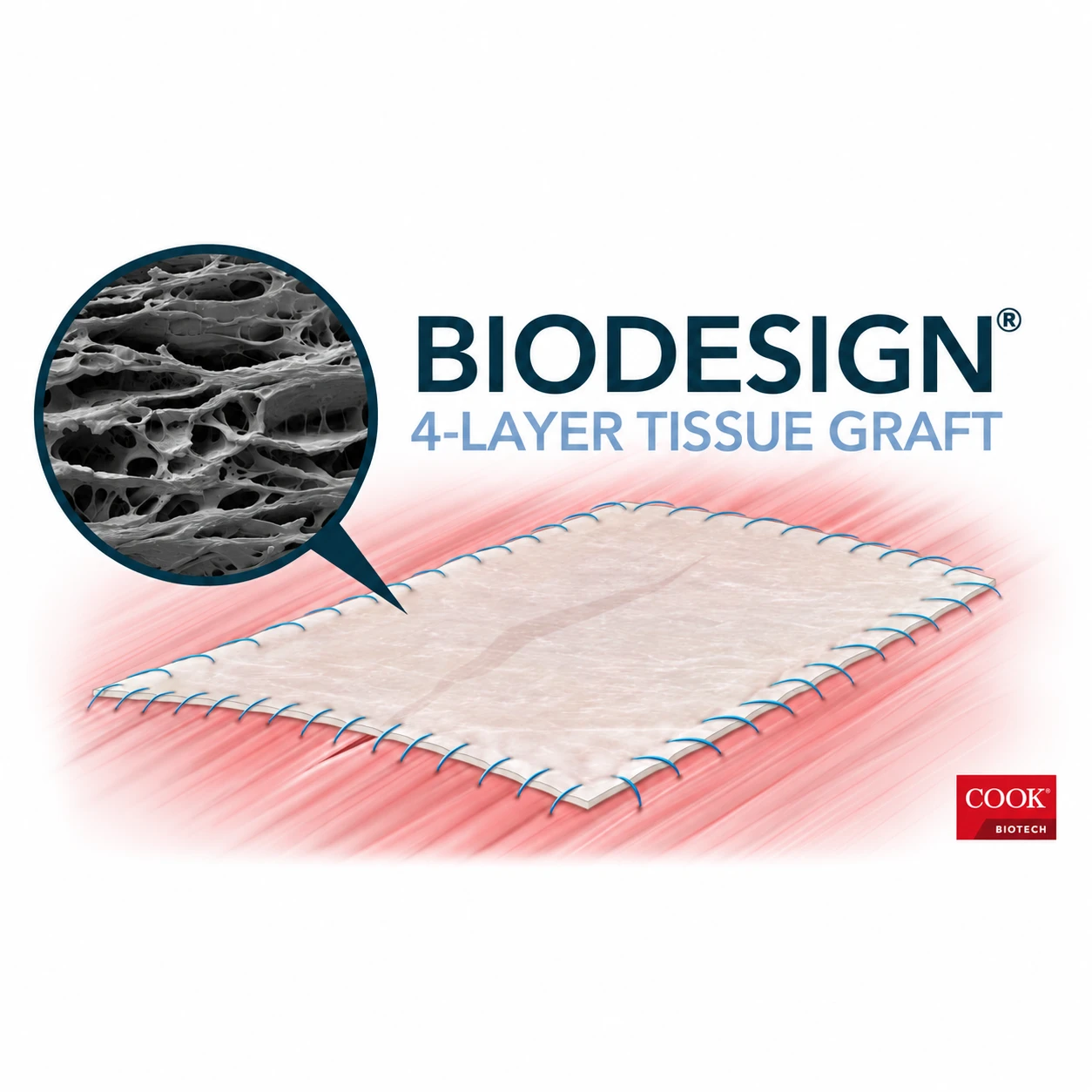
Product Description
The Cook Biodesign Tissue Support is a multilayer sheet of dried small intestinal submucosa (SIS). It is intended to reinforce soft tissue and may be
trimmed to fit the patient’s anatomy. The product is sterile and intended for single use only.
Intended Use
The Cook Biodesign Tissue Support is intended for implantation to reinforce soft tissue. It is supplied sterile in a peel-open package and is intended
for single use only.
Restrictions on Use
The product is intended for use only by trained healthcare professionals.
Contraindications
This product is derived from porcine tissue and must not be used in patients with known sensitivity to porcine-derived materials.
Precautions
1. This device is designed for single use only. Attempts to reprocess, resterilize, and/or reuse it may lead to device failure and/or diseasetransmission.
2. Do not resterilize. Discard all unused portions of the product after opening.
3. The product is sterile if the packaging is dry, unopened, and undamaged. Do not use if the package seal is broken.
4. Discard the product if improper handling may have caused damage or contamination, or if the expiration date has passed.
5. The product may not provide sufficient strength to withstand the stresses encountered in some ventral hernia or large body wall
repairs.
6. Ensure that the product is hydrated before suturing or fixation.
7. Patients receiving radiation therapy may experience impaired wound healing.
8. The performance of the graft has not been evaluated with suture spacing greater than 2 mm.
9. Ensure that all layers of the graft are securely incorporated during suturing or fixation.
Potential complications associated with the use of surgical graft materials include, but are not limited to:
.Inflammation.Allergic reaction
.Seroma formation
.Abscess
.Adhesions
.Fistula formation
.Induration
.Erosion
.Infection
.Tissue trauma
.Recurrence of the tissue defect
.Delayed or failed incorporation
.Migration
.Extrusion
.Fever
.Pain
.Bleeding
Removal of the device should be considered if any of the following conditions occur and cannot be resolved:
.Infection.Acute or chronic inflammation (initial use of surgical graft materials may be associated with transient, mild, localized inflammation)
.Allergic reaction
.Seroma formation
Storage
Store at room temperature in a clean, dry place.
Sterilization
The product is sterilized with ethylene oxide. Do not resterilize.
Required Materials
.A sterile tray or other suitable container, such as a bowl.Sterile forceps
.Hydration fluid: at least 50 mL of sterile saline or sterile lactated Ringer’s solution at room temperature per graft sheet
Note: Handle the product using aseptic technique. Minimize contact with latex gloves.
1. Using aseptic technique, remove the inner pouch containing the graft from the outer pouch and place it in the sterile field.2. Carefully open the inner pouch and aseptically remove the graft sheet using sterile forceps.
3. Place the graft sheet in a sterile tray within the sterile field. Multiple graft sheets may be hydrated simultaneously in the same tray.
4. Add at least 50 mL of hydration fluid per graft sheet to the tray.
5. Hydrate the graft in the fluid until the desired handling characteristics are achieved. Do not hydrate for more than 5 minutes.
6. Prepare the implantation site using standard surgical techniques.
7. Using aseptic technique, trim the graft sheet to fit the site, allowing a small margin for overlap.
8. Note: Alternatively, the graft sheet may be trimmed before hydration. If this approach is used, ensure that the graft is hydrated before suturing or fixation. Refer to Step 5.
9. Using aseptic technique, transfer the graft sheet to the implantation site and suture or secure it in place, avoiding excessive tension.
10. Note: Surgical experience indicates that close approximation of the graft sheet to the tissue during suturing or fixation is associated with better outcomes.
11. Complete the standard surgical procedure.
12. Discard any unused portions of the product in accordance with the institution’s medical waste disposal guidelines.