Home > Products > Wound Care > Photobiomodulation Therapy > EmoLED v.1
- Indications and Clinical Applications
- Product Overview and Principle of Operation
- Instructions for Use and Treatment Procedure
- Contraindications and Safety Precautions
EmoLED is designed for the adjunctive treatment of acute and chronic wounds as part of standard wound care. Applicable wound types and clinical
settings include:
- Post-traumatic ulcers and surgical wound dehiscence
- Inflammatory ulcers (vasculitis)
- Scleroderma ulcers
- Neuroischemic ulcers and diabetic foot ulcers
- Pressure ulcers and skin graft sites
- Acute lesions (skin grafting)
Treatment should be assessed by healthcare professionals based on the patient’s condition, wound type, and approved instructions for use, and
provided in conjunction with established standard wound care protocols.
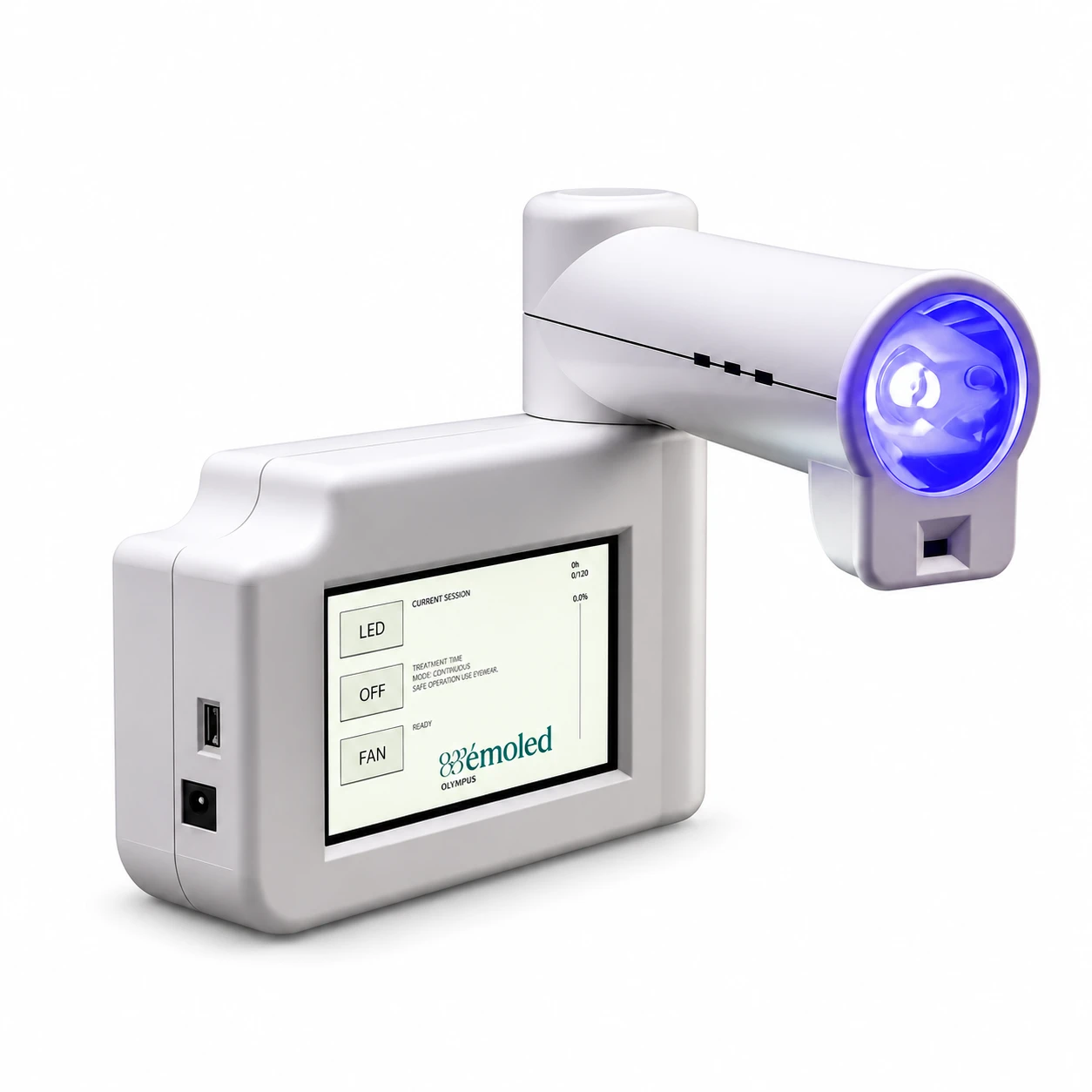
EmoLED is a handheld, non-contact LED phototherapy device equipped with six LED light sources that emit light at wavelengths of 400–430 nm.
Its optical system distributes the light evenly across the target area.
The device is intended for patients aged 16 years and older as an adjunctive therapy to support the healing of acute and chronic wounds.
Powered by a rechargeable lithium-ion battery, it enables cordless operation and provides an additional adjunctive treatment option for clinical
wound care.
EmoLED uses a non-contact irradiation approach. The light source should be positioned approximately 4 cm from the wound, maintaining
the recommended distance of 3–5 cm throughout treatment.
The device covers an area of approximately 20 cm² per exposure. Depending on the wound type, the recommended exposure time is 60 or 120
seconds per treatment area, with treatment performed once or twice a week.
For wounds larger than the area covered by a single exposure, treatment may be applied sequentially to separate areas in accordance with the
instructions for use, ensuring that each area receives the prescribed exposure. The wound should be cleaned before treatment, and the device
should be operated by healthcare professionals in accordance with the instructions for use.
EmoLED should be operated by healthcare professionals. Before use, assess the patient’s condition, verify that the device is functioning properly
, and observe the following safety precautions:
- Avoid direct exposure of the eyes to the light source. Personnel within the treatment area are advised to wear UV-protective eyewear.
- Maintain an appropriate distance between the device and the patient, avoiding direct contact with the wound.
- Clean and disinfect the device as instructed before use, and verify that the light output is functioning properly.
- Unauthorized personnel must not disassemble or repair the device.
- Use the charger supplied by the manufacturer and follow all applicable charging and operating restrictions.